“Art is for everybody.” — Keith Haring
Creativity is something we all have access to.
And yet for many of us, it’s the first thing we forget or let go of, especially those who are navigating the demands of caregiving, concern, and supporting a loved one with a severe and persistent mental illness. There never seems to be enough time or energy.
In our latest episode of Look Again: Mental Illness Re-Examined, we explored art therapy and the role creativity can play in supporting mental health with Nicole Parekh who is an art therapist, artist, and counsellor with a Master of Arts in Expressive Arts Therapy and Psychology.
Listen to the episode here:
Nicole uses the creative process as a therapeutic tool and aims to make it far more accessible than most people realize. You don’t need experience or talent. All you need is a few minutes and a willingness to try.
Before we begin
It helps to remember a few things.
Creativity is not a talent; it’s a way of operating in the world that is available to all of us. These activities are playful experiments, not tests. There is no right or wrong way to do them. The focus is on the process, not the result — on noticing what comes up for you as you engage, rather than on what you produce.
Find a quiet space, take a few deep breaths, and ask yourself what you need at this moment.
Are you looking for relaxation? Self-soothing? Play? Release? A distraction?
Let that guide you.
And if any of these activities bring up uncomfortable feelings or memories, it is okay to stop. These activities can be therapeutic; but not for everyone and not all the time. If you find yourself needing more support, an art therapist can offer a safe, non-judgmental space to explore further.
The Canadian Art Therapy Association has a directory to help you find someone who is a good fit, learn more here.
Art Activity 1: Moving with Music Time (2.5 minutes minimum)
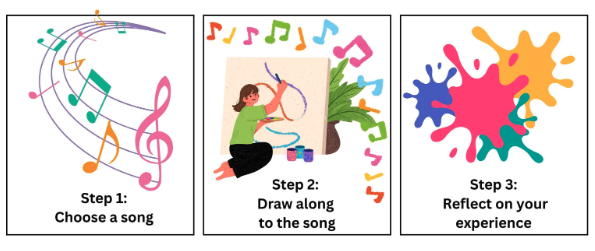
This is a wonderful place to start if you are art-curious but not quite sure where to begin.
Choose one of your favourite songs and queue it up. Grab a piece of paper and a pencil, pen, crayon, or marker — whatever feels comfortable. Hold it in your hand, turn the music on, and let it guide the movement of your hand across the page for the duration of the song.
This is not about making art. It is about moving to the music while spontaneously making marks on paper. Imagine letting the music flow through your hand and into the pencil, letting it take the lead wherever it wants to go. When the song ends, sit back and reflect on what emerged.
You can also try this with your eyes closed, using your non-dominant hand, standing up, or working outside. How does it feel with a fast percussive song compared to a gentle melodic one?
Art Activity 2: The Scribble Time (1–5 minutes minimum)
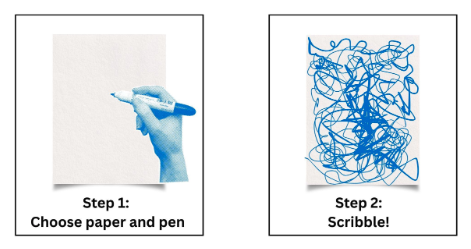
Who said scribbling is just for kids?
Scribbling is a simple, low-risk activity — a bit messy, a bit chaotic, and entirely spontaneous. The goal is not to make art. It is simply to make marks on paper. Scribbling can be a cathartic way to release stuck emotions and feelings and reducing that pent-up energy can help us feel more present and clearer.
Grab a pencil and paper and just — scribble. Press hard or soft. Make big or small movements. Cover the whole page or just part of it. Keep going until you feel finished.
If a blank page feels paralyzing, try starting with a single dot, or drop a random object onto the paper, trace its outline, remove it, and use that shape as your starting point.
Once you have covered the page, sit back and look at what is there. Just like finding shapes in clouds, see if any images are peeking out through the scribbles. Turn the paper around, look at it from different angles, and if something catches your eye, you can bring it out further with colour or detail.
Art Activity 3: Nature Collage (5–10 minutes minimum)
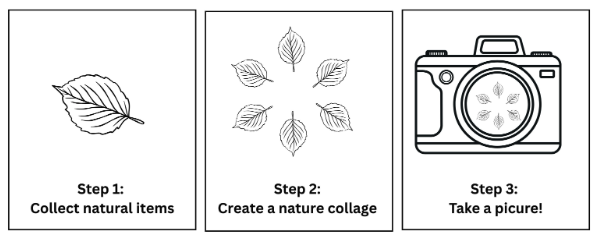
Go outside and find some green space. Take five to ten minutes to look around — in all directions — and notice what catches your eye. Collect a few items that have already fallen to the ground: twigs, leaves, petals. Be mindful not to harm any plants or nests in the process.
Find a quiet place to work and start arranging what you have collected in a way that feels pleasing to you. Notice the textures, colours, and details in your hands as you work. Let it become a spontaneous 2D image or 3D sculpture, whatever feels right.
When you are done, take a photograph of your collage and return the materials to nature.
Art Activity 4: Colour Hunt (5 minutes minimum)
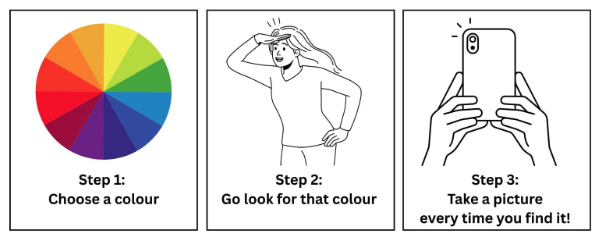
Most of us carry a powerful camera in our pockets every day. This activity puts it to use as a mindful practice.
Look around you and notice all the colours in your environment. Is there one that is pulling your attention? Choose that colour intentionally — something that is sparking something for you today — and spend five to ten minutes photographing everything you can find in that colour.
Don’t think too much about what the picture looks like.
Focus on seeking and finding. That single-pointed focus can help bring you into the present moment, challenge you to see a familiar environment in a new way, and offer an active, creative alternative to scrolling.
If you enjoy it, go home and look at all the photographs you took. You might find a collage waiting to be made.
Art Activity 5: Visual Journal (5 minutes a day)
“I found I could say things with color and shapes that I couldn’t say any other way — things I had no words for.” — Georgia O’Keeffe
Most people are familiar with the idea of a journal. But sometimes, words are not enough.
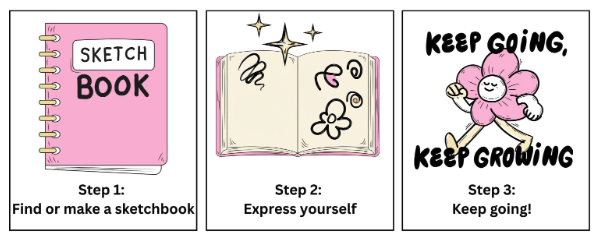
A visual journal is a sketchbook or notebook where you can express yourself through shapes, colours, and images — with or without words. You can rip out pages, glue things in, combine mediums, or keep it entirely private. You get to decide what goes in and what stays.
Try dedicating five minutes a day to your visual journal for one week. At the end of the week, look back at what emerged.
A visual journal is portable, affordable, and entirely yours. It can hold your doodles, your scribbles, your feelings, and your experiments. If you are feeling overwhelmed, having somewhere to put it all — somewhere outside of yourself — can be a quiet but powerful form of relief.
Art does not need to be big, polished, perfect, or finished. It just has to be yours.
We hope these activities offer you a small moment of relief, connection, or joy.
Share this episode with someone who might need to hear it too. Listen wherever you get your podcasts.